
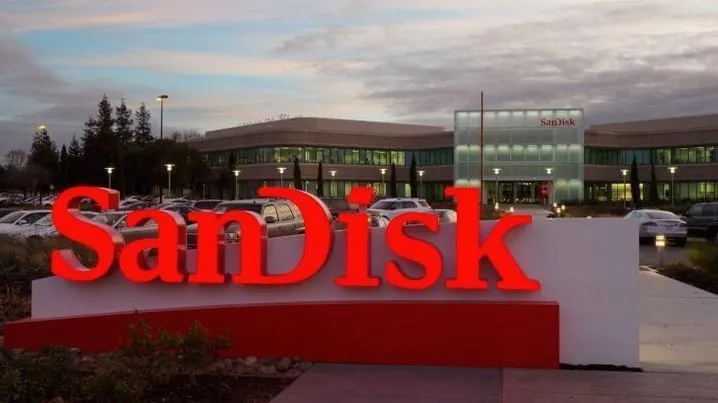
SanDisk stock (NASDAQ: SNDK) extended its decline on Friday, October 16, trading at $1,322.50, down 5.19%, as of 2:39 p.m. Eastern time. The move followed Thursday’s $1,394.83 close and pushed shares further below their short- and medium-term moving averages, even as Wall Street analysts maintained a considerably higher average price target.According to TipRanks, SanDisk’s average analyst target stands at $2,205.59, representing approximately 66.8% potential upside from Friday’s intraday quote. The same consensus implied 58.1% upside from Thursday’s closing price.The gap reflects two competing assessments of the memory-storage market: weakening near-term share-price momentum and continued analyst expectations for strong earnings supported by artificial intelligence infrastructure investment.TipRanks reported no new company-specific development behind Friday’s early weakness. Instead, investors were weighing concerns about AI spending, data-center financing, Chinese memory competition and profit-taking following the sector’s substantial rally.
SanDisk Stock Falls Despite a 3.3% Kospi Rebound
Friday’s weakness in memory stocks contrasted with a recovery across Asian equity markets. South Korea’s Kospi advanced 3.3%, while Japan’s Nikkei gained 1.9%, according to TipRanks.Despite that rebound, SanDisk, Micron Technology and SK Hynix all traded lower before the US opening bell.TipRanks reported SanDisk down 1.27% in premarket trading, Micron down 1.39% and SK Hynix down 2.92%. Their respective Thursday closing prices were $1,394.83, $931.24 and $146.11 for the US-listed securities.Premarket quotations varied by source and observation time. Benzinga reported SanDisk down 2.07% at $1,365.99, Micron down 2.13% at $911.40 and SK Hynix down 2.90% at $141.88.Together, those reports placed SanDisk’s early decline between approximately 1.3% and 2.1%. The subsequent regular-session fall was considerably larger.The movement suggests that the memory sector remained under pressure despite Friday’s broader Asian recovery. However, the available reporting does not establish a single company-specific catalyst for SanDisk’s decline.
SanDisk Trades Nearly 18% Below Its Moving Averages
SanDisk’s technical position has weakened substantially compared with its recent trading history.TipRanks reported a 20-day exponential moving average (EMA) of $1,620.82 and a 50-day EMA of $1,611.71. At Thursday’s $1,394.83 close, shares were approximately 13.9% and 13.5% below those respective levels.Using Friday’s $1,322.50 intraday price against those previously reported averages, the discounts widen to approximately 18.4% and 17.9%.Both moving averages remain well above the market price, supporting the Strong Sell technical signal identified by TipRanks. The figures are reference points from Friday’s earlier analysis rather than freshly recalculated intraday EMAs.SanDisk has experienced substantial appreciation during 2026, leaving investors with significant gains to protect as semiconductor sentiment weakens.The recent decline should therefore be considered alongside the magnitude of the preceding rally rather than treated as evidence that demand for NAND flash memory has suddenly disappeared.Investor Takeaway: SanDisk’s near-term technical picture is weak, but the decline has increased the mathematical upside implied by existing analyst targets. That does not independently establish that the stock is undervalued.
Why Wall Street Still Sees Upside Toward $2,205
Despite negative technical indicators, TipRanks assigns SanDisk a Strong Buy analyst consensus, with an average price target of $2,205.59.Analyst averages vary by provider and coverage universe. Stock Analysis, for example, reported a $2,173 average target across 25 analysts on Friday, also implying substantial upside from the current trading price.The bullish outlook reflects expectations that elevated NAND pricing, enterprise solid-state drive demand and AI-related storage requirements can sustain strong earnings.Earlier this month, Citi reiterated a Buy rating and $2,100 target for SanDisk after Micron disclosed approximately 30% NAND pricing growth in its fiscal fourth quarter.As FinanceFeeds previously explained in its coverage of Citi’s SanDisk outlook, the relationship between NAND pricing and SanDisk’s earnings remains central to the company’s investment case.SanDisk’s own financial performance provides support for that assessment. The company reported fiscal fourth-quarter 2026 revenue of $8.97 billion, up 51% sequentially, with approximately two-thirds of that revenue growth attributed to higher pricing.For its fiscal first quarter of 2027, SanDisk guided revenue to $10.30 billion–$10.80 billion and non-GAAP diluted earnings per share to $44–$46.However, high earnings expectations create additional risk. Even if NAND prices continue increasing, slower pricing growth or weaker forward guidance could pressure a valuation built around sustained profitability.
AI Financing and Chinese Competition Remain Key Risks
Much of the pressure affecting memory stocks has originated outside the companies themselves.Investors are increasingly questioning the cost of AI infrastructure expansion, particularly among data-center operators relying on substantial borrowing to finance new capacity.CoreWeave has become a prominent example. Its unsecured notes due in 2032 recently traded at distressed prices, with yields exceeding 15%, reflecting increased concern about credit risk and financing requirements.FinanceFeeds’ October 15 analysis of CoreWeave’s bond yields examined how debt-market stress preceded the company’s equity selloff.That pressure matters indirectly for memory suppliers. If financing becomes more expensive for AI infrastructure operators, investors may begin questioning whether planned capital spending will translate into orders at the pace currently anticipated.Chinese competition presents a separate issue. ChangXin Memory Technologies (CXMT) has reported progress in advanced DRAM designs, raising questions about future memory supply and pricing competition.However, DRAM and NAND are different technologies. CXMT’s reported breakthrough concerns DRAM, while SanDisk specializes in NAND flash storage. Any direct impact on SanDisk remains uncertain rather than demonstrated.FinanceFeeds’ October 14 Micron stock analysis examined how China’s DRAM developments and broader market conditions were affecting investor expectations.
What Could Change the Outlook for SanDisk Stock?
SanDisk’s next confirmed earnings announcement is scheduled for October 29, when the company will report fiscal first-quarter 2027 results.Investors will be looking for revenue against the $10.30 billion–$10.80 billion guidance range, realized NAND pricing, enterprise storage demand and management’s outlook for subsequent quarters.The durability of its elevated gross margins and the contribution of higher-value data-center customers will be particularly important for assessing whether analyst earnings assumptions remain achievable.Investor Takeaway: The $2,205.59 consensus target indicates considerable expected upside, but October 29 earnings will provide a more concrete test of the assumptions behind that valuation.For now, SanDisk stock sits well below its recent moving averages while analyst expectations remain significantly above the market price. Whether that gap narrows through a recovery in the shares or downward revisions to price targets will depend increasingly on evidence from earnings and the outlook for NAND pricing.